
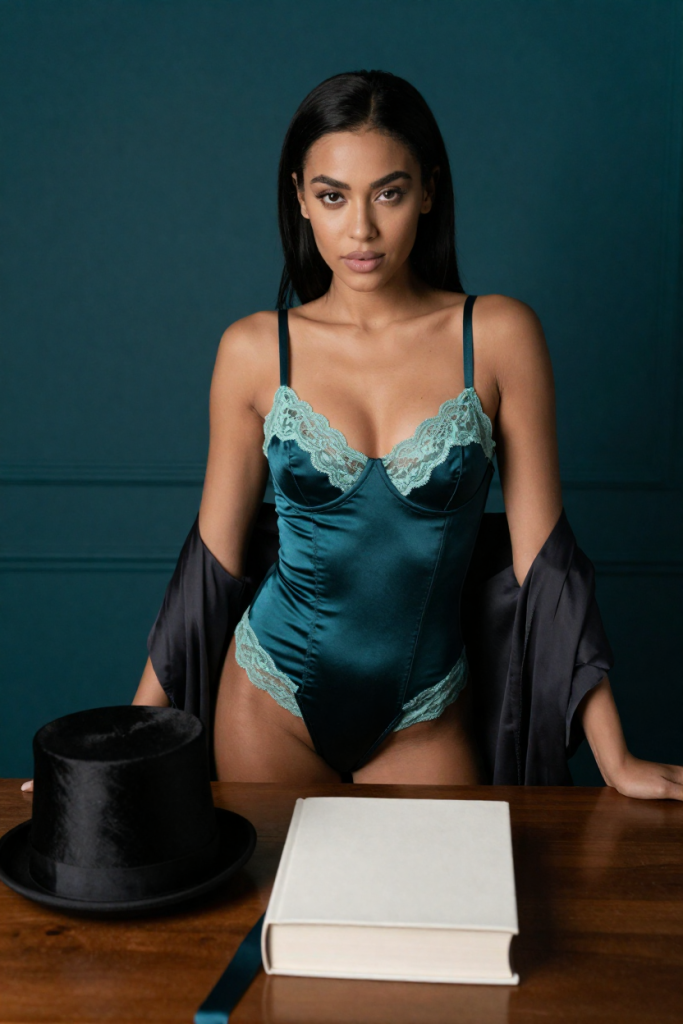
The top-hat card is five lines long, and its brevity is the point. A card you can paste at the head of every prompt is a card you will actually paste; a page of description stays in a drawer while the prompt gets rewritten from memory, and memory is where characters go to change. Five lines, in a fixed order, written once and never edited in the middle of a set.
Age, as a plain number
Write ’29-year-old woman’, not ‘young woman’. Numbers render; adjectives negotiate. The house keeps its muses plainly in their late twenties.
Hair: colour, length, style
Three facts, one of them a habitual style — ‘glossy black hair in a sleek centre-parted fall’. A style she always wears is worth two she sometimes does.
Build in two or three words
‘Tall, statuesque build.’ More words buy less consistency, not more.
Face: two enduring details
Strong brows, full lips — details that survive a change of outfit, angle and hour.
One signature
A plain ribbon at the wrist, a small mark — one thing that identifies her in a tight crop where hair and build are out of frame.
The line that is allowed to change
Below the card goes one changing line: outfit, setting, light. Everything a sitting needs to be new lives in that line, and nothing else does. The discipline feels strict for a week and then starts paying: frames begin to agree with each other, culling gets faster, and the tools downstream — edits, swaps, upscales — stop being asked to repair identity and can get on with finishing.
Questions
Can I change the card between series?
Between series, yes — that is what a new card is for. Inside a series, never.
What if a line keeps rendering wrong?
Reword that line once, plainly, before the set begins. Mid-set edits are how two versions of her end up in one pack.
Do two characters share a card format?
The format, yes; the card, never. Two characters, two cards, filed separately.