
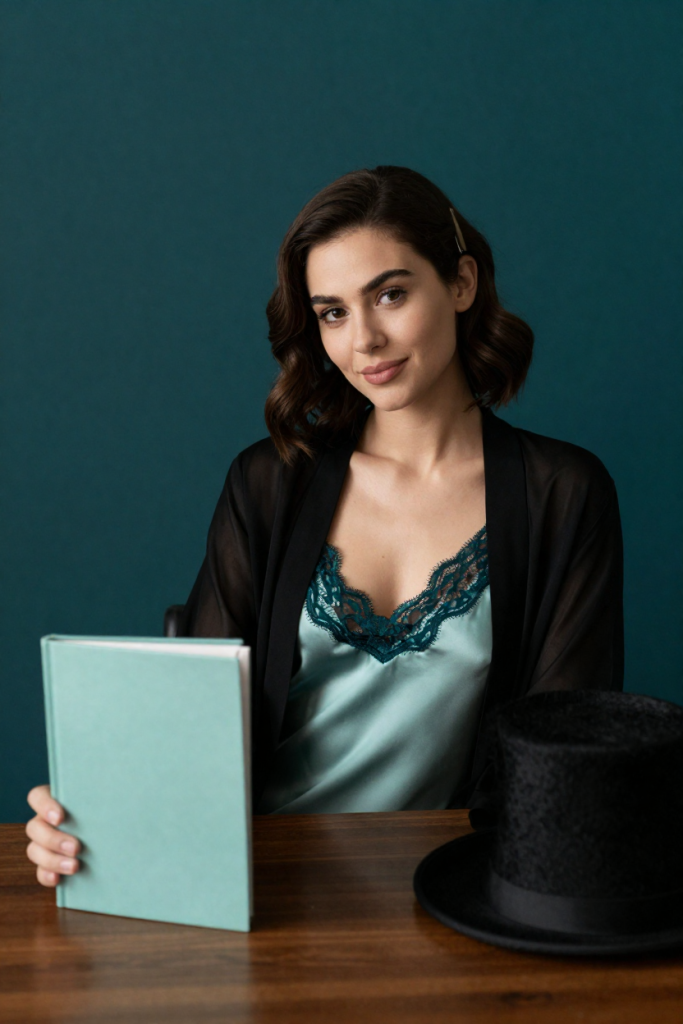
The top-hat room photographs the way it does because its light is treated as staging: one warm key light, deep teal walls to receive it, and nothing in the room that competes with skin for the eye. Members ask how to borrow the look for their own series. The answer is unglamorous: the look is two decisions, repeated. A named key light and a named wall colour, written identically in every brief.
Light belongs on the changing line — barely
Light is allowed to change between sittings — a warmer hour, a lower lamp — but it changes as a decision, one at a time, never as an accident of re-briefing. The card holds the woman; the changing line holds outfit, setting and light, in words a stagehand could follow: ‘warm key light from the left, deep teal wall behind’. Vague light (‘moody’, ‘dramatic’) is re-rolled by the model every frame, and a series lit by dice looks like it.
Dressing the small room
Keep the desk, the closed biography and the hat; let everything else be wall. A small, fixed set outperforms a new location per frame for the same reason a stage does: the audience stops reading the room and starts reading the person. When a frame needs novelty, change her outfit and the hour — the room has done its work by staying still.
Questions
What light words work best?
Direction, warmth and source: ‘soft window light’, ‘warm lamplight from the left’. Concrete nouns beat adjectives.
Can I use a different wall colour?
Yes — name it once and hold it. The teal is the house’s choice, not a rule.
Why does the book stay in frame?
It is the bench mark: a plain, letter-free cover against which drift in everything else becomes visible.